📚 Topic: Introduction to Philosophy
Bayes’ Theorem is a standard result from probability theory that formalizes how rational belief should change when new information becomes available.
It is not just a mathematical formula.
It captures a general principle of reasoning:
beliefs should be updated in light of evidence, but in proportion to how strong and how informative that evidence actually is.
This post works through that idea carefully, using concrete examples.
🧠 What Is Bayes’ Theorem?
Bayes’ Theorem gives a rule for calculating the probability of a hypothesis after observing some evidence.
It connects three things:
- what you believed before seeing the evidence
- how expected the evidence would be if the hypothesis were true
- how common that evidence is overall
Formally:P(H∣E)=P(E)P(E∣H)×P(H)
Where:
- P(H | E) — the probability of the hypothesis given the evidence (the updated belief)
- P(H) — the prior probability of the hypothesis (what you believed before)
- P(E | H) — the probability of observing the evidence if the hypothesis were true
- P(E) — the overall probability of observing the evidence at all
A useful way to read the formula is:
start with how plausible the hypothesis already was,
strengthen or weaken it depending on how well it predicts the evidence,
and scale that by how common the evidence is in general.
🧪 Example 1: Symptoms and a Rare Disease
Suppose you wake up feeling sick and notice symptoms that seem to match a rare disease called Hypothetica.
You naturally ask:
“Given these symptoms, how likely is it that I have the disease?”
Assume the following:
- P(H) = 0.0001
(1 person in 10,000 has the disease) - P(E | H) = 0.95
(if someone has the disease, they almost always show these symptoms) - P(E) = 0.01
(1% of people show these symptoms for various reasons)
Using Bayes’ Theorem:P(H∣E)=0.010.95×0.0001=0.0095
So the updated probability is:
- 0.0095, or 0.95%
What matters here
Even though the symptoms are very likely given the disease, the disease itself is extremely rare, and the symptoms occur for many other reasons.
Bayes’ Theorem forces both facts to be taken into account at the same time.
🎯 The Base Rate Insight
A common mistake is to confuse these two probabilities:
- P(E | H) — how likely the symptoms are if you have the disease
- P(H | E) — how likely you have the disease given the symptoms
They are not the same.
Ignoring how rare something is (its base rate) leads to overconfidence.
Bayes’ Theorem makes that mistake explicit and correctable.
📦 Example 2: Hoodie and Package Theft
Now consider a different case.
You see someone wearing a hoodie near your porch shortly after a neighbor warned about package theft.
Let:
- H = “This person is a package thief”
- E = “This person is wearing a hoodie”
Assume:
- P(H) = 0.001
(1 in 1,000 people are package thieves) - P(E | H) = 0.95
(most thieves wear hoodies) - P(E) = 0.3
(30% of people wear hoodies)
Bayes’ Theorem gives:P(H∣E)=0.30.95×0.001=0.00317
That is about 0.3%.
What this shows
Wearing a hoodie slightly increases suspicion, but not nearly as much as intuition might suggest.
The evidence is weak because hoodies are common.
Bayes’ Theorem prevents overreaction to familiar-looking “signals.”
🧠 What Bayes’ Theorem Is Really Doing
At a conceptual level, Bayes’ Theorem is about updating, not jumping.
- Evidence should change your belief
- but the size of that change must be constrained by:
- how rare the hypothesis is
- how common the evidence is
Strong-looking evidence can still lead to small probability shifts when base rates are low.
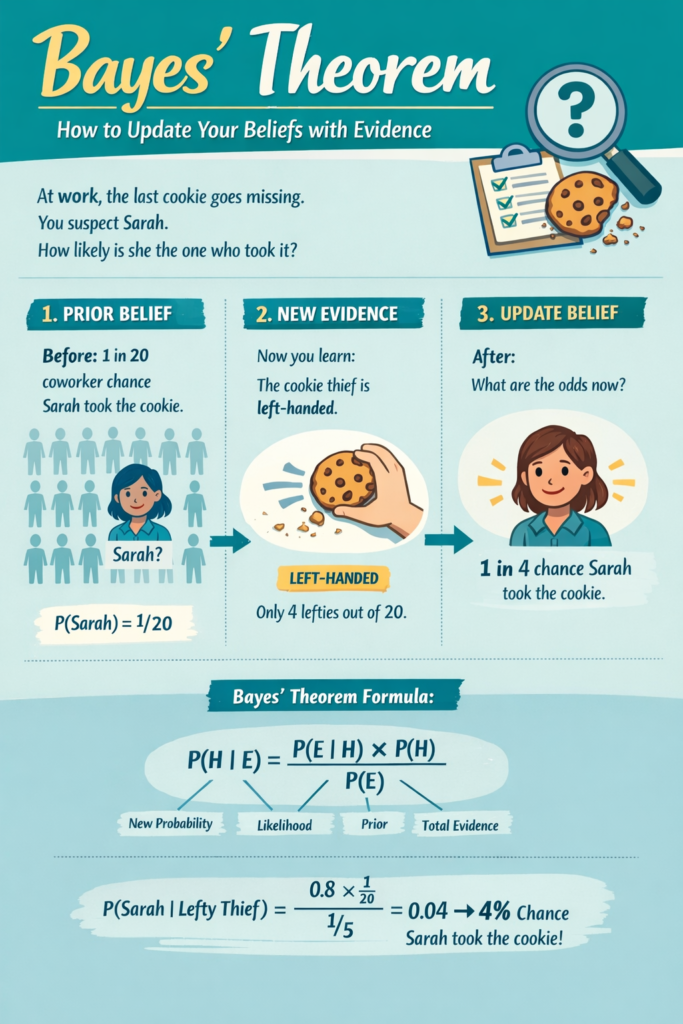
🍪 Example 3: The Missing Cookie
There are 20 coworkers. One cookie is gone.
Before any clues:
- P(Sarah did it) = 1/20 = 5%
This is your prior.
Now you learn:
“The person who took the cookie is left-handed.”
Suppose there are 4 left-handed coworkers, including Sarah.
What changes?
- Sarah was 1 of 20 possible suspects
- she is now 1 of 4 plausible suspects given the new evidence
So her probability increases from 5% to 25%.
This is Bayes’ reasoning in informal form:
- start with a baseline
- incorporate new information
- restrict attention to the group consistent with that information
The belief changes, but it does not become certain.
📌 What to Remember
- Bayes’ Theorem formalizes rational belief updating
- It combines prior belief with new evidence
- Rare hypotheses remain unlikely unless evidence is unusually specific
- The goal is not certainty, but better calibrated confidence
Even without the formula, the core idea is this:
new evidence should shift what you believe
but only as much as the evidence actually justifies.
🎶 Use This Song to Memorize It
🎧 While studying this, the core definitions were turned into a short song as a memory aid.
The song doesn’t add content, it simply repeats the same ideas in another form.
Lyrics are included below so you can read, sing, or listen along if repetition helps.
🎤 Song Lyrics:
(Sing, read, or hum along, repetition helps!)

Update The Odds

Bayes’ theorem shows me how
To change beliefs, here and now
When I learn a brand new clue
My old belief updates too

Not yes or no, not black or white
Just raise or lower odds at night
I keep the base, adjust the guess
Bayes gives structure to the mess

🧠  Prior belief, then evidence
How likely is that clue if the case makes sense?
Multiply both, then don’t forget:
Divide by how likely the clue is... you’re set

Say a cookie has gone missing
Lots of kids, but only one did it
You hear the thief wore red shoes
Sarah’s one, but so are a few

If red shoes are common gear
The clue’s weak, the odds stay near
But if red shoes are super rare
Then Sarah’s chance climbs in the air

🧠  Prior belief, then evidence
How likely is that clue if the case makes sense?
Multiply both, then don’t forget:
Divide by how likely the clue is... you’re set

Don’t confuse these two, they’re not the same:
P of E given H - not P of H given E’s name
If you skip the base rate, you might fall
That’s the base rate fallacy, it fools us all

Prior belief, then evidence
Bayes helps you think with intelligence
Odds go up, or maybe down
One clue alone won’t wear the crown
📝 Test Yourself: Bayes’ Theorem
Read each scenario and think before opening the answer.
Focus on how probabilities change when new evidence appears.
1. Question: What is a prior probability? ▾ Open to see answer
✅ Your starting belief
- The probability you assign before getting new evidence.
- It reflects what you already know about the situation.
2. Scenario: Only 1 out of 30 people stole a cookie. Question: What does this number represent? ▾ Open to see answer
✅ The prior probability
- This is your base rate before learning anything else.
- It sets your starting point.
3. New evidence: The cookie thief is a girl. Question: What should you do next? ▾ Open to see answer
✅ Update your belief
- You narrow the group of suspects.
- You revise the probability instead of guessing emotionally.
4. Question: What mistake does Bayes’ Theorem help avoid? ▾ Open to see answer
❌ The base rate fallacy
- Ignoring how common something is overall.
- Focusing only on new evidence and forgetting the prior.
5. True or False: Bayes’ Theorem gives certainty. ▾ Open to see answer
❌ False
- It gives a better estimate, not a guarantee.
- It updates belief, not truth.
6. Core idea: What does Bayes’ Theorem really teach? ▾ Open to see answer
✅ How to think rationally with uncertainty
- Start with what you know.
- Add new evidence carefully.
- Update your belief step by step.