📚 Topic: Introduction to Philosophy
🚨 What Is the Fallacy of Composition?
In introductory philosophy and logic, a fallacy of composition is an informal fallacy.
It happens when someone assumes that what is true of the parts must also be true of the whole, without enough justification.
In short:
Parts have a property.
Therefore, the whole has that same property.
Sometimes this works.
Very often, it does not.
That mistake is the fallacy of composition.
🧠 Reminder: What Makes This an Informal Fallacy?
A quick refresher.
- A formal fallacy is an error in the structure of an argument.
- An informal fallacy is an error in the content or assumptions.
The fallacy of composition is informal because the logical form can look fine, but the content makes an unjustified leap.
🔍 The Core Pattern
Here is the basic reasoning pattern:
- Premise: Each part of X has property P.
- Conclusion: Therefore, X has property P.
This looks reasonable.
But it only works when the property really transfers from parts to whole.
That is exactly what must be checked.
❌ Classic Fallacy Examples (New and Concrete)
Example 1: Lightweight Parts
- Premise: Each component of this laptop is lightweight.
- Conclusion: Therefore, the laptop is lightweight.
This might be false.
Even if every part is light, the whole can still be heavy when assembled.
The mistake is assuming the property transfers automatically.
Example 2: Fast Workers
- Premise: Every worker on this team is fast.
- Conclusion: Therefore, the team completes projects quickly.
Not necessarily.
Coordination problems, communication issues, or poor planning can slow the group down.
Fast parts do not guarantee a fast whole.
Example 3: Quiet Instruments
- Premise: Each instrument in the orchestra sounds quiet on its own.
- Conclusion: Therefore, the orchestra will sound quiet.
False.
Together, those instruments can be very loud.
🧪 A Mathematical-Style Example
- Premise: 4 is even.
- Premise: 6 is even.
- Conclusion: Therefore, 4 + 6 is even.
This works.
But compare it to this:
- Premise: 3 is odd.
- Premise: 7 is odd.
- Conclusion: Therefore, 3 + 7 is odd.
That conclusion is false.
Same structure. Different property behavior.
This shows why checking the property matters.
🐾 A Familiar Physical Example
- Premise: Each brick in the wall is small.
- Conclusion: Therefore, the wall is small.
Clearly false.
Size does not transfer from parts to whole.
⚠️ Why the Fallacy Is Tempting
The fallacy of composition feels persuasive because:
- The premises are often true.
- The conclusion sounds intuitive.
- Our brains like shortcuts.
But logic requires asking one extra question:
Does this property actually carry over from parts to whole?
If the answer is unclear or unsupported, the argument fails.
✅ When the Reasoning Is NOT a Fallacy
Important point.
This style of reasoning is not always wrong.
Example:
- Premise: Every part of this chair is made of wood.
- Conclusion: Therefore, the chair is made of wood.
Here, the inference is reasonable.
The fallacy only occurs when there is no good reason to assume the property transfers.
📊 Quick Study Table
| Parts Have Property | Whole Has Property | Valid Inference? |
|---|---|---|
| Made of matter | Made of matter | Yes |
| Small | Small | No |
| Lightweight | Lightweight | Not guaranteed |
| Even numbers | Even sum | Sometimes |
| Quiet alone | Quiet together | No |
🧠 Key Takeaway
The fallacy of composition is:
- An informal fallacy
- Based on assuming parts and wholes share the same properties
- Only a fallacy when that assumption is unjustified
Whenever you see reasoning move from parts → whole, pause and ask:
Does this property really transfer?
If not, you may have spotted a fallacy.
🎶 Use This Song to Memorize It
🎧 While studying this, the core definitions were turned into a short song as a memory aid.
The song doesn’t add content, it simply repeats the same ideas in another form.
Lyrics are included below so you can read, sing, or listen along if repetition helps.
🎤 Song Lyrics:
(Sing, read, or hum along, repetition helps!)

 Fallacy of Composition

In logic class, in study notes,
We learn how arguments work.
Some mistakes are not in logic form,
But in the jump from parts to whole.

You hear facts that all sound true,
And still the conclusion fails.
That kind of error has a name,
And this is how it goes.

🧠  Fallacy of composition
Means this simple mistake:
What is true of each small part
Is assumed of the whole thing made

Fallacy of composition
Is the wrong step people take
From parts to whole
Without good reason
That’s the error, that’s the break

Each brick is small and light to lift
But the wall is heavy, thick, and strong
Each player whispers on their own
Together the crowd is loud and long

Atoms have no color at all
Still the cat is white or grey
True facts about the tiny parts
Do not always scale that way

🧠 Fallacy of composition
Means this simple mistake:
What is true of each small part
Is assumed of the whole thing made

Fallacy of composition
Is the wrong step people take
From parts to whole
Without good reason
That’s the error, that’s the break

This is an informal fallacy,
The problem is the content used.
The premises can all be true,
But the conclusion is not justified.

Sometimes the move is reasonable,
Sometimes it clearly is not.
Logic asks one extra question:
Do the parts support the whole or not?

Fallacy of composition:
Parts do not guarantee the whole.
Fallacy of composition:
Check the step. Check the rule.
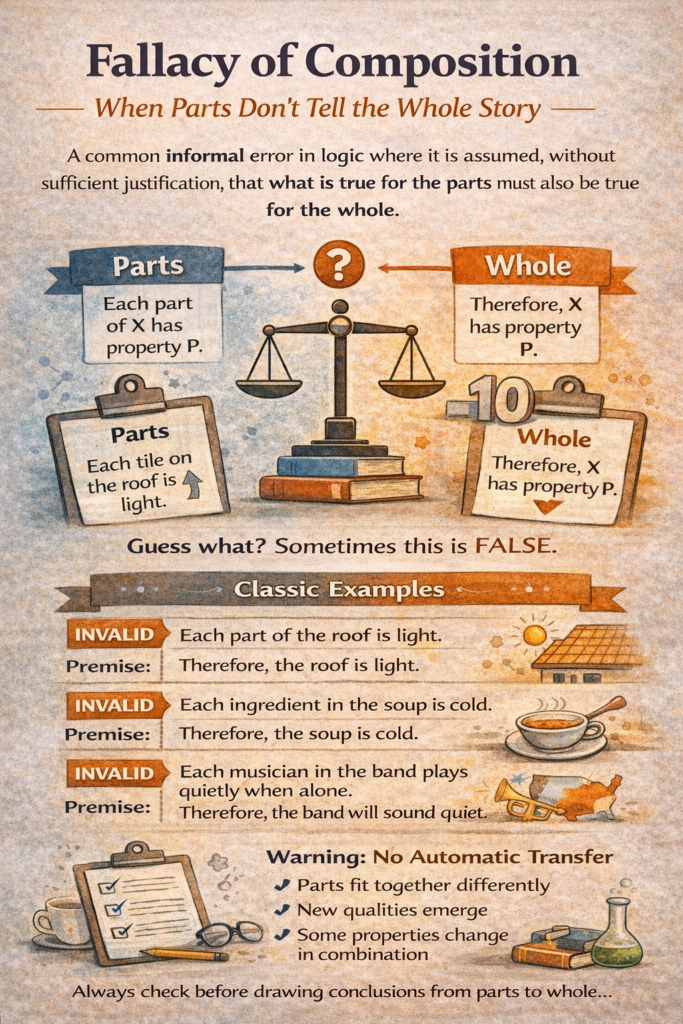
🧠 Test Yourself: Fallacy of Composition
Decide whether each argument commits the fallacy of composition or whether the reasoning is acceptable.
1. Premise: Each tile on the roof is light. Conclusion: Therefore, the roof is light. ▾ Open to see answer
❌ Fallacy of Composition
- Why: Even if each tile is light, the combined roof may be heavy.
- The property does not automatically transfer from parts to whole.
2. Premise: Every ingredient in the soup is cold. Conclusion: Therefore, the soup is cold. ▾ Open to see answer
❌ Fallacy of Composition
- Why: Heating can change the property of the whole.
- Temperature does not necessarily transfer from parts to the finished dish.
3. Premise: Each musician in the band plays quietly when alone. Conclusion: Therefore, the band will sound quiet. ▾ Open to see answer
❌ Fallacy of Composition
- Why: Sounds combine.
- Quiet parts can produce a loud whole.
4. Premise: Every chapter of this book is written in English. Conclusion: Therefore, the book is written in English. ▾ Open to see answer
✅ Reasonable Inference (Not a Fallacy)
- Why: Language is a property that normally transfers from parts to whole.
5. Premise: Each employee is efficient on their own. Conclusion: Therefore, the organization is efficient. ▾ Open to see answer
❌ Fallacy of Composition
- Why: Coordination and structure matter.
- Efficiency of individuals does not guarantee efficiency of the whole system.
6. Premise: Every part of the statue is made of bronze. Conclusion: Therefore, the statue is made of bronze. ▾ Open to see answer
✅ Reasonable Inference (Not a Fallacy)
- Why: Material composition transfers reliably from parts to whole.