📚 Topic: Introduction to Philosophy
What Is an Ad Hominem Fallacy?
In introductory logic and critical thinking, an ad hominem fallacy occurs when an argument is dismissed by attacking the person who made it, rather than by examining the argument itself.
The term ad hominem comes from Latin and roughly means “to the person.”
Instead of asking:
“Is this claim true or well supported?”
the discussion shifts to:
“What kind of person is saying this?”
That shift is the error.
The Core Idea
❌ Criticizing the speaker does not evaluate the argument.
✅ Arguments stand or fall based on reasons and evidence, not personal traits.
A Simple Example
Argument
- Premise: Working fewer hours improves focus and productivity.
- Conclusion: A shorter workweek could improve employee performance.
Response
“You only think that because you’re lazy.”
This response does not address the premises or the conclusion.
It attacks the person instead of the reasoning.
That is an ad hominem fallacy.
Why This Is a Fallacy
Even if the speaker were lazy, biased, or unpleasant, the argument could still be:
- logically valid
- supported by evidence
- worth serious consideration
Personal qualities and truth are separate questions.
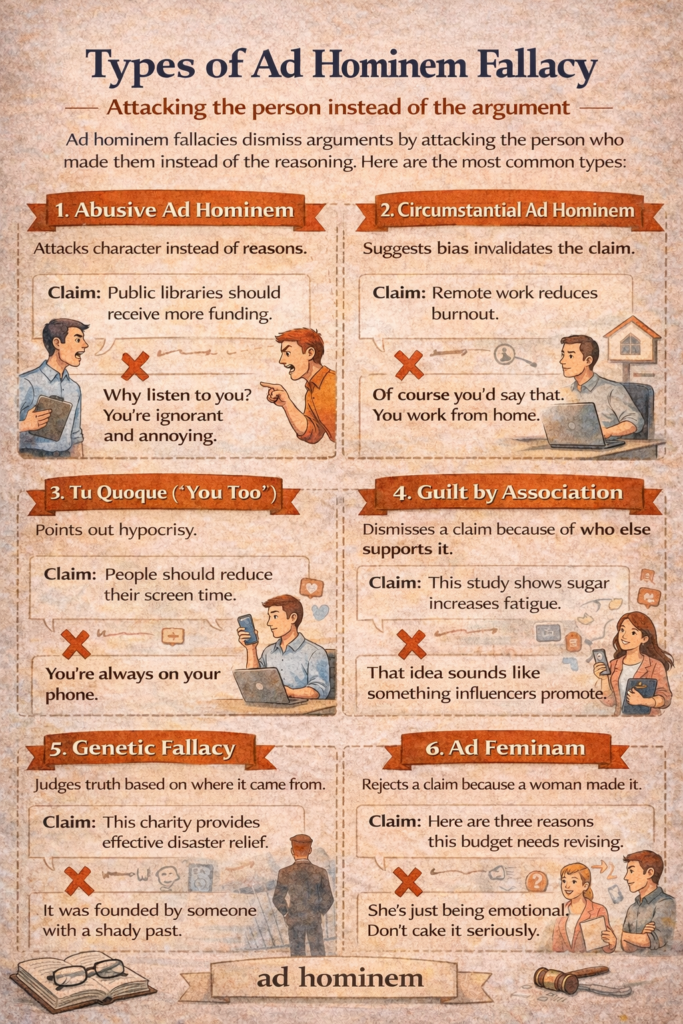
Common Types of Ad Hominem Fallacies
Philosophy textbooks distinguish several subtypes of ad hominem reasoning.
All of them share the same basic mistake: the argument is ignored in favor of a personal attack.
Overview Table
| Type | What Goes Wrong | Short Explanation |
|---|---|---|
| Abusive ad hominem | Direct personal insult | Attacks character instead of reasons |
| Circumstantial ad hominem | Motives or interests questioned | Suggests bias invalidates the claim |
| Tu quoque | Hypocrisy highlighted | Rejects a claim because the speaker does not follow it |
| Guilt by association | Association used as criticism | Dismisses a claim because of who else supports it |
| Genetic fallacy | Origin of the claim attacked | Judges truth based on where it came from |
| Ad feminam | Gender-based dismissal | Rejects a claim because a woman made it |
Examples of Each Type
1. Abusive Ad Hominem
Direct personal attack
Claim:
“Public libraries should receive more funding.”
Reply:
“Why listen to you? You’re ignorant and annoying.”
The argument is never addressed. Only the person is attacked.
2. Circumstantial Ad Hominem
Attacking motives or interests
Claim:
“Remote work reduces burnout.”
Reply:
“Of course you’d say that. You work from home.”
Possible self-interest does not refute the claim itself.
3. Tu Quoque
Pointing out hypocrisy
Claim:
“People should reduce their screen time.”
Reply:
“You’re always on your phone.”
Whether the speaker follows the advice does not determine whether the advice is good.
4. Guilt by Association
Claim:
“This study shows that sugar increases fatigue.”
Reply:
“That idea sounds like something influencers promote.”
Who else agrees has no bearing on whether the study is correct.
5. Genetic Fallacy
Judging a claim by its origin
Claim:
“This charity provides effective disaster relief.”
Reply:
“It was founded by someone with a shady past.”
A claim’s origin does not determine its current truth or effectiveness.
6. Ad Feminam
Gender-based personal attack
An ad feminam fallacy occurs when a claim is dismissed because it was made by a woman, rather than because of any flaw in the argument.
Example
“Why should we take her proposal seriously? She’s just being emotional.”
Here:
- No premise is examined
- No evidence is discussed
- The argument is rejected based on gender
Whether the proposal is good depends on its reasons and evidence, not on who presented it.
When Personal Factors Do Matter
Not every reference to a person is fallacious.
Personal factors can be relevant when:
- evaluating testimony
- assessing expertise
- identifying conflicts of interest as evidence, not dismissal
The fallacy occurs when personal criticism replaces reasoning, instead of contributing relevant information.
Quick Study Table
| Focus | What Happens |
|---|---|
| ❌ Fallacy | Person attacked instead of argument |
| ✅ Proper critique | Premises, logic, or evidence examined |
| 🔍 Key test | “Did this response address the claim itself?” |
Why This Fallacy Is So Common
Ad hominem reasoning is tempting because it can:
- feel emotionally satisfying
- shut down discussion quickly
- avoid engaging with complex reasoning
It appears frequently in:
- social media debates
- politics
- online reviews
- everyday disagreements
Key Takeaway
An argument is not false because of who says it.
It is false only if the reasons fail.
Learning to spot ad hominem fallacies helps you:
- think more clearly
- argue more fairly
- stay focused on what actually matters
🎶 Use This Song to Memorize It
🎧 While studying this, the core definitions were turned into a short song as a memory aid.
The song doesn’t add content, it simply repeats the same ideas in another form.
Lyrics are included below so you can read, sing, or listen along if repetition helps.
🎤 Song Lyrics:
(Sing, read, or hum along, repetition helps!)

 Ad Hominem - Against the Person

In logic and critical thinking,
Some replies don’t touch the claim.
They change the subject quietly,
And point their finger at a name.

🧠 Ad hominem
Means against the person, not the claim
You attack who is speaking
Instead of checking what they say

Ad hominem
Does not test truth or proof
Arguments stand or fall
On reasons, not on you

Abusive ad hominem, hear the name
You say, “Public transport needs more funding.”
They say, “You’re ignorant and annoying.”
No premise checked, no reason weighed,
Just insults doing the talking.

Circumstantial ad hominem, that’s the claim
You say, “Remote work lowers burnout.”
They say, “You only say that ’cause it helps you.”
Your situation takes the spotlight now,
And the argument slips out of view.

Tu quoque  “you too”, that’s the line
You say, “People should sleep more.”
They say, “But you stay up late.”
Hypocrisy gets pointed out,
But the advice still waits its fate.

Guilt by association, watch the trick
You say, “This study shows sugar causes crashes.”
They say, “That sounds like influencer talk.”
Who else agrees becomes the issue,
Instead of checking what the data shows.

Genetic fallacy, mark it down
You say, “This charity helps in disasters.”
They say, “It started from a shady past.”
The origin replaces the evidence,
And the present claim is never asked.

Ad feminam, a biased turn
You say, “Here’s a proposal for change.”
They say, “You’re just emotional.”
Gender is used to shut it down,
And the reasoning stays out of range.


Ad hominem
Against the person, not the claim
If the speaker is the target
Then the argument stays the same

Ad hominem
Learn to spot the move
Truth depends on reasons
Not on who is you

If the reply avoids the reasons
And talks about who is speaking instead,
That’s not criticism
That’s ad hominem.
🧠 Test Yourself: Ad Hominem Fallacies
For each item, decide: Is this an ad hominem?
If yes, which type? Then open to check.
1. Claim: “We should add more bike lanes downtown.” Reply: “You’re clueless. You don’t even know how cities work.” ▾ Open to see answer
❌ Ad Hominem: Abusive
- Why: The reply insults the speaker instead of addressing the reasons for bike lanes.
2. Claim: “Remote work can reduce burnout for some roles.” Reply: “Of course you’d say that. You work from home.” ▾ Open to see answer
❌ Ad Hominem: Circumstantial
- Why: It attacks motives (possible self-interest) instead of engaging the claim or evidence.
3. Claim: “People should reduce their sugar intake.” Reply: “You ate dessert last night, so your advice is worthless.” ▾ Open to see answer
❌ Ad Hominem: Tu Quoque
- Why: Points to hypocrisy to dismiss the claim, instead of evaluating the reasons.
4. Claim: “This plan could cut costs without reducing service.” Reply: “That’s the same kind of idea those annoying pundits push.” ▾ Open to see answer
❌ Ad Hominem: Guilt by Association
- Why: Dismisses the claim because of who else is associated with it, not because it’s wrong.
5. Claim: “This charity’s program is effective in disaster relief.” Reply: “It was founded by someone with a shady past, so it can’t be good.” ▾ Open to see answer
❌ Ad Hominem: Genetic Fallacy
- Why: Judges the claim/program by its origin rather than the current evidence.
6. Claim: “Here are three reasons this budget needs revising.” Reply: “She’s just being emotional. Don’t take it seriously.” ▾ Open to see answer
❌ Ad Hominem: Ad Feminam
- Why: Dismisses the argument by gendered stereotyping instead of addressing the reasons.
7. Claim: “This policy is risky because it increases failure points.” Reply: “That might be true, but you were rude in the meeting.” ▾ Open to see answer
🟡 Not an Ad Hominem Refutation (Just a Topic Shift)
- Why: This doesn’t actually refute the claim at all. It changes the subject to behavior.
- Key test: The reply never evaluates the reasons for “risky policy.”
8. Claim: “This witness says the light was green.” Reply: “They were 200 meters away and it was foggy, so their testimony is unreliable.” ▾ Open to see answer
✅ Not a Fallacy (Relevant to Testimony)
- Why: This critiques reliability in a context where credibility and observation conditions matter.
- Note: It addresses evidence quality, not character as a shortcut to dismissal.