📚 Topic: Introduction to Philosophy
What Does “Valid” Mean in Philosophy?
In everyday language, calling something “valid” often means that it sounds reasonable or that one agrees with it.
In philosophy and logic, validity has a more specific meaning.
Validity concerns the structure of an argument, not whether its statements are actually true.
A First Characterization
An argument is valid when its reasoning works in such a way that:
If all the premises were true, the conclusion could not be false.
This definition focuses entirely on logical form.
Whether the premises are true or false is a separate question.
What Is an Argument?
In philosophy, an argument is a set of statements consisting of:
- one or more premises (the reasons), and
- a conclusion (the claim those reasons are meant to support).
Example:
- Premise 1: All desserts contain sugar.
- Premise 2: A croissant is a dessert.
- Conclusion: A croissant contains sugar.
If the premises are true, the conclusion must be true.
For that reason, the argument is valid.
Validity and Truth Are Not the Same
Validity does not mean that the premises are true.
It means that the conclusion follows logically assuming they are.
This is why philosophers often say:
- validity tests reasoning,
- truth tests statements.
A Useful Definition
In standard logic textbooks, validity is defined as follows:
An argument is valid if and only if it is impossible for all the premises to be true while the conclusion is false.
This definition explains why validity is independent of real-world facts.
Valid Arguments with False Premises
Consider the following argument:
- Premise 1: All pumpkins can sing.
- Premise 2: This vegetable is a pumpkin.
- Conclusion: This vegetable can sing.
The premises are clearly false.
However, if they were true, the conclusion would have to be true as well.
For that reason, the argument is:
- valid (the structure is correct),
- not sound (because the premises are false).
This illustrates an important point:
validity checks structure first; truth is evaluated separately.
An Invalid Argument
Now consider this argument:
- Premise 1: All owls are birds.
- Premise 2: My cat is a bird.
- Conclusion: My cat is an owl.
At first glance, the argument mentions related categories.
However, the conclusion does not follow from the premises.
Both premises could be true while the conclusion is false.
The mistake lies in confusing:
- belonging to a general category, with
- being a specific kind within that category.
Because the structure does not guarantee the conclusion, the argument is invalid.
Validity Does Not Depend on Meaning
Consider an argument using made-up terms:
- Premise 1: All zargs are flom.
- Premise 2: Glib is a zarg.
- Conclusion: Glib is flom.
Even without knowing what these words mean, the argument is valid.
Why?
Because it follows a standard deductive form:
- All X are Y.
- Z is an X.
- Therefore, Z is a Y.
Validity depends on this structure, not on the content of the terms.
Summary Table
| Item | What it is | Can it be true or false? |
|---|---|---|
| Statement | A single claim | Yes |
| Argument | A set of statements | No |
| Valid argument | Conclusion follows from premises | Yes |
| Invalid argument | Conclusion does not follow | Yes |
Why Validity Matters
Validity allows philosophers to examine the logic of an argument independently of its content.
Only after establishing validity do we ask whether the premises are true.
When an argument is both valid and has true premises, it is called sound.
Key Point to Remember
- Validity concerns structure.
- Truth concerns statements.
- An argument can be valid even if its premises are false.
For now, validity answers one question only:
Does the reasoning work?
🎶 Use This Song to Memorize It
🎧 While studying this, the core definitions were turned into a short song as a memory aid.
The song doesn’t add content, it simply repeats the same ideas in another form.
Lyrics are included below so you can read, sing, or listen along if repetition helps.
🎤 Song Lyrics:
(Sing, read, or hum along, repetition helps!)

What Makes It Valid

What is logic? It’s a way to think,
Step by step, not just how we feel.
It’s how we build ideas that link
A path where truth and reason meet.

Logic looks at how things connect,
Not if the words are real or correct.
It checks the shape, it checks the form
That’s how logic keeps thought warm.

If the premises are true,
And the logic works too,
Then the conclusion must be right
That’s what makes it valid.

You don’t need truth in every line,
You only need the parts to align.
If “All X are Y” and “Z is X,”
Then “Z is Y” is what comes next.

“Pumpkins can sing,” might sound absurd,
But if the logic fits the words,
Then even silly things can count
That’s what makes it valid.

Logic doesn’t ask “is this true?”
It only asks, “Does it follow through?”
Does the end come from the start?
That’s how logic does its part.

Even made-up stuff can pass,
Like “Zargs” and “Flom” in class.
If the structure fits just right
That’s what makes it valid.

True or false? That’s not the test.
Logic checks the structure best.
If it flows from A to B
That’s what makes it valid.

So don’t confuse it with the truth,
An argument can lie to you.
Valid just means form is sound
That’s what makes it valid.

Step by step, you learn to see
How logic builds from A to Z.
It’s like a bridge that must hold tight
That’s what makes it valid.
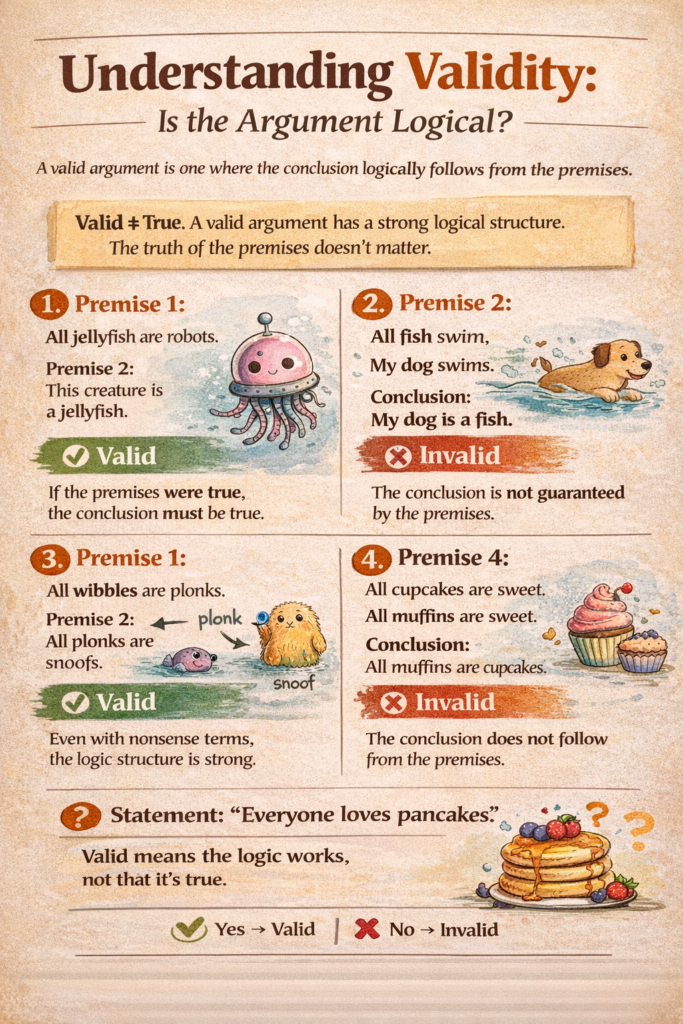
🧠 Self-Check: Validity
For each case, consider whether the conclusion follows logically from the premises.
Decide before opening the explanation.
1. Premise 1: All jellyfish are robots. Premise 2: This creature is a jellyfish. Conclusion: This creature is a robot. ▾ Open to see analysis
Valid
- Reason: If both premises were true, the conclusion would have to be true.
- The truth of the premises is irrelevant to validity.
2. Premise 1: All fish swim. Premise 2: My dog swims. Conclusion: My dog is a fish. ▾ Open to see analysis
Invalid
- Reason: The premises do not guarantee the conclusion.
- This form commits the error of affirming the consequent.
3. Premise 1: All wibbles are plonks. Premise 2: All plonks are snoofs. Conclusion: All wibbles are snoofs. ▾ Open to see analysis
Valid
- Reason: The argument has the form: All A are B; all B are C; therefore all A are C.
- Meaningless terms do not affect logical validity.
4. Premise 1: All cupcakes are sweet. Premise 2: All muffins are sweet. Conclusion: All muffins are cupcakes. ▾ Open to see analysis
Invalid
- Reason: The conclusion introduces a relationship not supported by the premises.
- The premises can be true while the conclusion is false.
5. Premise 1: If it is snowing, the ground will be white. Premise 2: It is snowing. Conclusion: The ground will be white. ▾ Open to see analysis
Valid
- Reason: This is an instance of modus ponens, a standard valid deductive form.
6. Statement: Everyone loves pancakes. ▾ Open to see analysis
Not an argument
This is a single statement. There are no premises offered in support of a conclusion.