📚 Topic: Introduction to Philosophy
In everyday language, words like true and logical are often used interchangeably.
In philosophy and logic, however, truth and validity refer to different properties.
Understanding the distinction between them is essential for evaluating arguments correctly.
What Is Truth?
Truth is a property of statements.
A statement is true when it matches reality, and false when it does not.
Examples:
- “The sun is hot.” → True
- “Bananas are made of metal.” → False
Truth and falsity apply to individual claims, not to entire arguments.
What Is Validity?
Validity is a property of arguments, not statements.
An argument is valid when its structure guarantees the conclusion, assuming the premises are true.
Validity does not depend on whether the premises are actually true.
A common way to express this is:
An argument is valid if it is impossible for all its premises to be true while the conclusion is false.
A Structural Way to Think About Validity
Consider the following abstract form:
- If A = B
- and B = C
- then A = C
This form is valid regardless of what A, B, and C stand for.
Even if the terms are fictional or nonsensical, the logical structure remains correct.
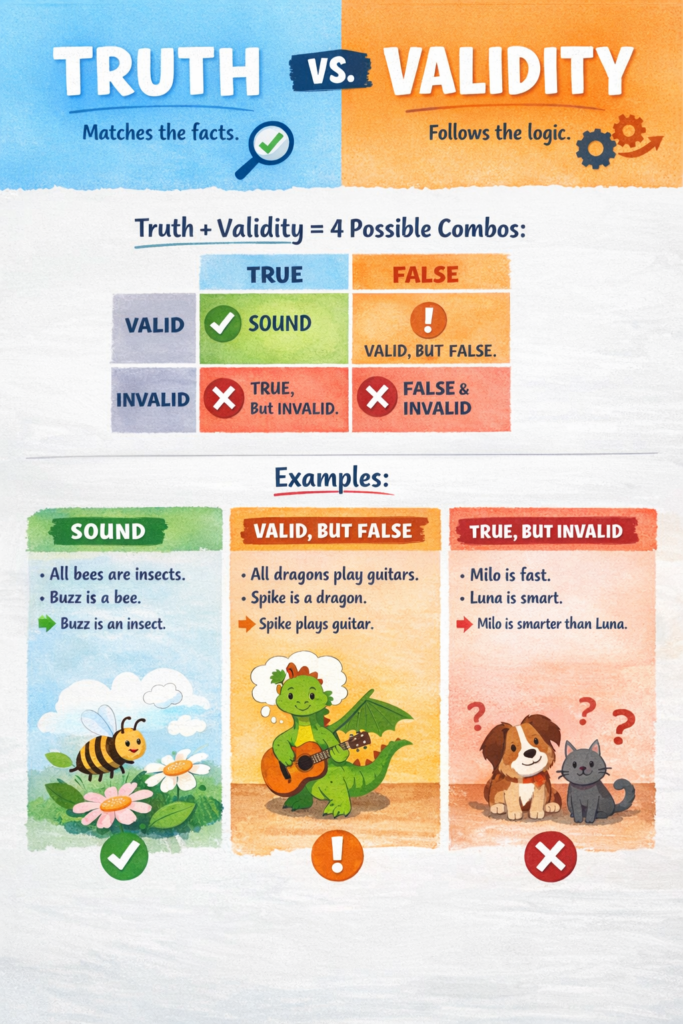
Truth and Validity Combined
Truth and validity can come together in different ways.
The important point is that they are independent properties.
| Premises | Conclusion | Valid? | Sound? |
|---|---|---|---|
| True | True | Yes | Yes |
| True | False | No | No |
| False | True or False | Yes | No |
| False | True or False | No | No |
Only one combination produces a sound argument:
true premises combined with valid reasoning.
Example 1: True Premises + Valid Structure
- Premise 1: All bees are insects.
- Premise 2: Violet is a bee.
- Conclusion: Violet is an insect.
The reasoning is valid, and the premises are true.
This argument is sound.
Example 2: False Premises + Valid Structure
- Premise 1: All cupcakes can sing.
- Premise 2: This muffin is a cupcake.
- Conclusion: This muffin can sing.
The premises are false, but the conclusion follows logically from them.
This argument is valid, but not sound.
Example 3: True Premises + Invalid Structure
- Premise 1: My dog likes carrots.
- Premise 2: My cat likes tuna.
- Conclusion: Therefore, my dog and cat are vegetarians.
The premises may be true, but they do not support the conclusion.
This argument is invalid.
Why the Distinction Matters
Validity allows us to examine the logic of an argument independently of its content.
If an argument is valid and the conclusion is false, the error must lie in the premises.
If an argument is invalid, no amount of true premises can save it.
This separation is why philosophers analyze arguments in two steps:
- Check validity
- Then evaluate truth
Key Points to Remember
- Truth applies to statements.
- Validity applies to arguments.
- A valid argument can still be false.
- A true conclusion can come from bad reasoning.
- Soundness requires both validity and true premises.
Keeping these distinctions clear is central to careful reasoning.
🎶 Use This Song to Memorize It
🎧 While studying this, the core definitions were turned into a short song as a memory aid.
The song doesn’t add content, it simply repeats the same ideas in another form.
Lyrics are included below so you can read, sing, or listen along if repetition helps.
🎤 Song Lyrics:
(Sing, read, or hum along, repetition helps!)

🎶 Truth Is Fact, Valid Is Form

Truth is about the world we see,
Facts that match reality.
If it rains and streets are wet,
Then that statement’s true

Truth belongs to statements alone,
True or false, that’s all they own.
Arguments aren’t true or false,
That’s not their job, that’s not their role.

Truth is fact, truth is real,
What the world can prove and feel.

Valid is about how things connect,
Step by step, what follows next.
If the premises are true and clear,
Does the conclusion have to be here?

Validity is structure only,
Not if the story’s strange or phony.
Even if the facts are wrong,
The logic still can carry on.

Truth is fact, valid is form,
Truth is world, logic’s norm.

Truth is about reality,
Validity is necessity.
If premises were true somehow,
Would the conclusion follow now?

If yes, the argument is valid.
If no, the structure’s broken, invalid.

Truth can fail while logic stands,
Logic checks the reasoning plan.
Sound is when they meet at last:
Valid form and true facts.

Truth is fact, valid is form,
Say it slow, repeat the norm.
Truth is world, valid is shape,
That’s how arguments escape mistakes.

Truth is fact
Valid is form
Sound is both
Remember that
📝 Self-Check: Truth and Validity
For each case, identify what can be evaluated (truth of statements, validity of an argument, or soundness).
Decide before opening the explanation.
1. Premise 1: All koalas are dancers. Premise 2: Luna is a koala. Conclusion: Luna is a dancer. ▾ Open to see analysis
Valid, not sound
- Valid: If the premises were true, the conclusion would have to be true.
- Not sound: At least one premise is false.
2. Premise 1: My shoes are wet. Premise 2: The sky is cloudy. Conclusion: It rained on Saturn. ▾ Open to see analysis
Invalid
- Reason: The conclusion does not follow from the premises.
- The premises could be true while the conclusion is false.
3. Premise 1: All dogs are mammals. Premise 2: Bibi is a dog. Conclusion: Bibi is a mammal. ▾ Open to see analysis
Valid and sound
- Valid: The conclusion follows from the premises.
- Sound: The premises are true.
4. Premise 1: All turtles love jazz music. Premise 2: Milo is a turtle. Conclusion: Milo loves jazz music. ▾ Open to see analysis
Valid, not sound
- Valid: The argument has a standard valid form.
- Not sound: A premise is unsupported / likely false.
5. Premise 1: If it is Monday, I wear green socks. Premise 2: I am wearing green socks. Conclusion: Therefore, it is Monday. ▾ Open to see analysis
Invalid
- Reason: The conclusion does not follow from the premises (affirming the consequent).
- The premises could be true while the conclusion is false.