📚 Topic: Introduction to Philosophy
You’ve seen claims like these:
- “People who eat more nuts have lower bad cholesterol.”
- “Students who sit near the front of the class get better grades.”
- “It’s sunny today! I’m definitely going to ace this test.”
These statements describe patterns.
The key question is:
Does one thing cause the other or do they just happen together?
This is the difference between correlation and causation.
Just Because It Happens Together…
People often say things like:
“Every time I wear my lucky socks, we win.”
That might be true as a pattern.
But are the socks actually doing anything?
This is one of the most common reasoning traps:
confusing correlation with causation.
We see it everywhere, headlines, social media, everyday thinking:
- “Kids who eat breakfast score higher on tests.”
- “Ice cream sales and drowning deaths rise in summer.”
- “People who floss live longer.”
And then we jump to conclusions:
- “Breakfast causes intelligence!”
- “Flossing is the secret to immortality!”
Before jumping, it helps to slow down.
🧠 What Is Correlation?
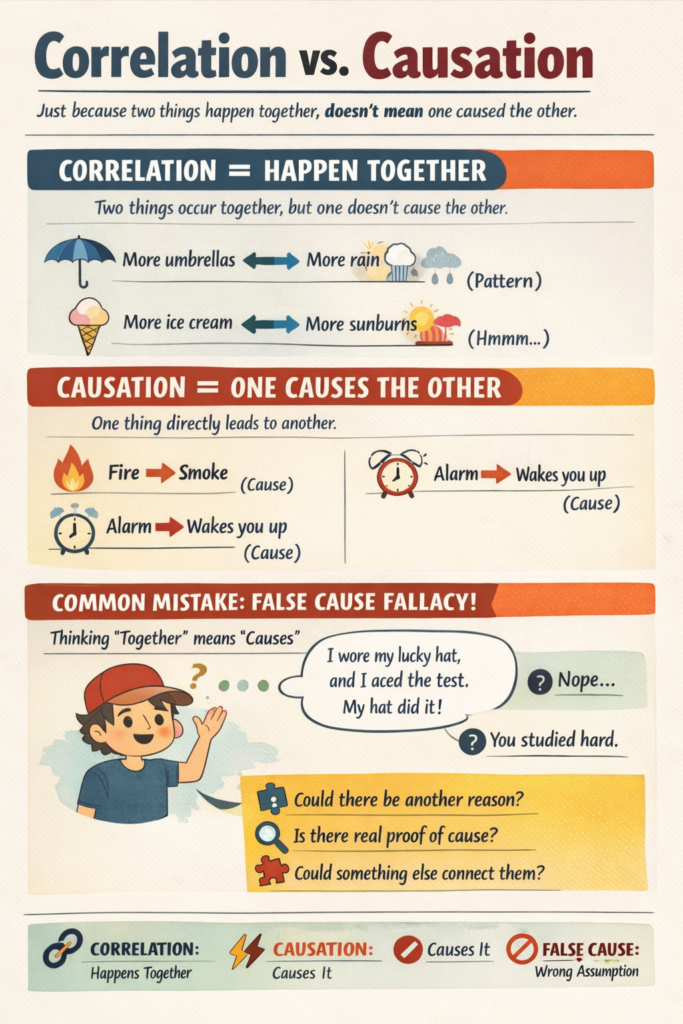
Correlation means that two things tend to occur together.
They may increase together, decrease together, or move in opposite directions.
Examples
Example 1 (positive correlation)
When hand soap sales increase, flu cases also increase.
Example 2 (negative correlation)
When winter begins, ice cream sales drop.
These are real patterns.
But patterns alone do not tell us why they happen.
🔍 What Is Causation?
Causation means that one thing actually produces another.
If A causes B, then changing A would reliably change B.
Examples:
- Turning on a kettle causes water to boil.
- Skipping sleep for several nights causes exhaustion.
Causation has a direction:
A → B
Correlation does not guarantee this direction or any direction at all.
🤷 Where We Get Confused
Consider this reasoning:
“Every time I bike to work, I feel happier.
Biking must cause happiness.”
That might be true but the correlation alone doesn’t prove it.
Other explanations are possible:
- you bike only on sunny days, and sunlight affects mood
- you bike when you’re already in a good mood
- biking and happiness are both effects of something else
At this point, all we really know is that biking and happiness occur together.
That’s correlation, not proof of causation.
📌 Why This Matters
Mistaking correlation for causation can lead to:
- wasted time and money (“miracle” health habits)
- misleading claims in the media
- poor decisions and policies
Examples:
- “Every time I eat blueberries, my headaches go away.”
→ Could be coincidence. - “When I sleep 8 hours, I feel better the next day.”
→ Promising, but is sleep the cause, or something else that comes with it?
Correlation suggests a question, not an answer.
🧪 How to Test a Causal Claim
When you hear:
“X causes Y”
Ask yourself:
- Do X and Y simply happen together?
- Could Y be causing X instead?
- Could a third factor be causing both?
Example
“People who own more books have smarter kids.”
Does that mean books cause intelligence?
Maybe.
But maybe parents who buy books also read more, talk more, and support learning more.
Always ask:
Could something else explain the pattern?
🔁 Correlation Isn’t Useless
Correlation still matters.
It’s often the starting point:
- a clue
- a pattern
- something worth investigating further
Just don’t treat it as proof.
“They’re connected”
is not the same as
“One causes the other.”
🎓 Quick Study Table
| Term | Meaning | Example |
|---|---|---|
| Correlation | Two things tend to occur together | More umbrellas = more rain |
| Causation | One thing produces another | Fire causes smoke |
| False cause | Assuming causation from correlation | Ice cream causes sunburn |
🧠 One Thing to Remember
All causal relationships involve correlation.
But many correlations are not causal.
Keeping that distinction clear helps you spot:
- bad arguments
- misleading studies
- faulty everyday reasoning
🎶 Use This Song to Memorize It
🎧 While studying this, the core definitions were turned into a short song as a memory aid.
The song doesn’t add content, it simply repeats the same ideas in another form.
Lyrics are included below so you can read, sing, or listen along if repetition helps.
🎤 Song Lyrics:
(Sing, read, or hum along, repetition helps!)

It Happens, But It Doesn't Cause

It happens, but it doesn't cause
Just because it rains when I pause
Doesn’t mean the clouds made me sad
Sometimes two things just... overlap

When grades go up with hours slept
You might think sleep is why they’re prepped
But maybe they just both come from
Good habits learned when we were young

🧠  Correlation's not causation
Don't mistake the situation
Two events that rise or fall
Could be nothing much at all
Could be something else that links them
Could be just a sweet illusion
Don't be fooled by how it looks
Patterns lie in data books

A rooster crows when morning comes
But roosters don’t bring out the sun
They're synced in time, that part is true
But one’s not causing what you do

A friend who runs and eats whole grain
Might have low chance of heart disease pain
But maybe running’s what helps most
Or maybe genes, not whole-wheat toast

🧠  Correlation's not causation
Don't confuse the explanation
Two things paired might not connect
Even if you might suspect
Always ask what else could do it
What’s behind it? Can we prove it?
Logic isn’t just a vibe
Test the claim before you buy

So next time someone makes a claim
"Hey, X caused Y
it’s all the same!"
Stop and ask, “what else is there?”
Think like a scientist, be fair

It happens, but it doesn’t cause
Let the question be your compass
Curious minds don’t jump too fast
Correlation’s not built to last
🧠 Test Yourself: Correlation or Causation?
Can you spot the difference between simple correlation and real cause? Open to see the answers and explanations.
1. Observation: Every time Mia brings her yellow backpack, it rains later that day. ▾ Open to see answer
❌ Correlation (Not Causation)
- No causal link: The weather does not respond to backpack colors.
- Likely coincidence or an unnoticed seasonal pattern.
2. Observation: After switching to a standing desk, Sam reports fewer back pains. ▾ Open to see answer
✅ Could Indicate Causation (Needs More Evidence)
- Plausible cause: Changing posture and habits can reduce back strain.
- Need more data: Could still be coincidence or placebo effect.
3. Observation: People who eat cereal tend to wake up earlier. ▾ Open to see answer
❌ Correlation (Not Causation)
- Confounding factor: Morning people are more likely to eat breakfast.
- Correlation exists, but cereal does not cause earlier wake times.
4. Observation: Whenever local ice cream sales go up, drowning incidents also rise. ▾ Open to see answer
❌ Correlation (Not Causation)
- Common cause: Hot weather increases swimming and ice cream consumption.
- No direct link: Ice cream does not cause drowning.
5. Observation: After daily running, Ava notices her stress levels go down. ▾ Open to see answer
✅ Potential Causation
- Evidence-backed link: Exercise reduces stress biologically.
- Reasonable to infer: Regular running may be the cause.