📚 Topic: Introduction to Philosophy
In introductory logic and philosophy, a fallacy is a mistake in reasoning.
A fallacious argument can feel convincing.
It can sound logical, confident, or emotionally appealing.
But when examined carefully, something goes wrong.
Learning about fallacies is not about being clever.
It is about noticing when reasoning fails, even if it feels persuasive.
🚨 What Is a Fallacy?
A fallacy is an argument that looks acceptable on the surface but does not actually support its conclusion.
This can happen in two main ways:
- the structure of the argument is broken
- the content of the argument is misleading
These give us the two standard categories.
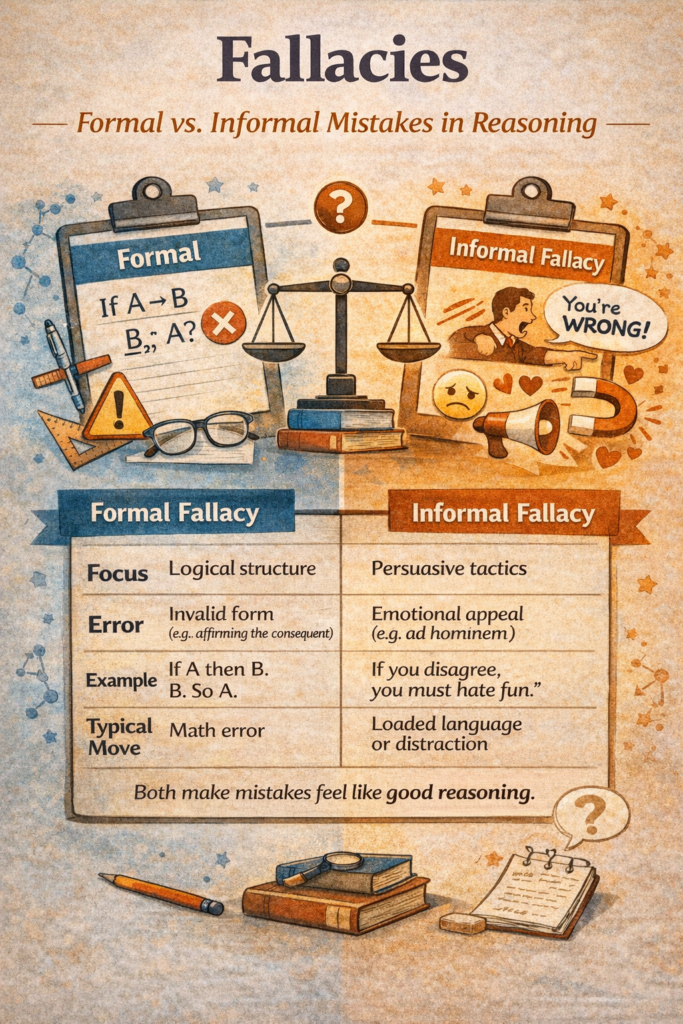
Two Main Types of Fallacies
- Formal fallacies
Errors in the logical structure of an argument - Informal fallacies
Errors in how ideas, language, or assumptions are used
This distinction helps locate the problem.
Is the logic itself broken, or is the reasoning misleading in another way?
📐 Formal Fallacies
When the Structure Is the Problem
A formal fallacy happens when an argument follows an invalid logical form.
Even if every sentence sounds reasonable, the conclusion does not logically follow from the premises.
Think of it like a math error.
If the formula is wrong, the result cannot be trusted.
Example: Formal Fallacy
Premise 1: If someone lives in Paris, then they live in France.
Premise 2: Leo lives in France.
Conclusion: Therefore, Leo lives in Paris.
This conclusion does not follow.
Living in France does not guarantee living in Paris.
Leo could live in many other cities.
This mistake is called affirming the consequent.
The general pattern looks like this:
- If A, then B
- B
- Therefore, A
Any argument with this structure is invalid, no matter the topic.
💬 Informal Fallacies
When the Content Is the Problem
An informal fallacy occurs when the structure may look fine, but the reasoning still fails.
The problem comes from:
- misleading assumptions
- emotional pressure
- vague or loaded language
- changing meanings
Here, the issue is not the skeleton of the argument, but what is being done with the ideas.
Example: Informal Fallacy
Premise 1: Dogs are better than cats.
Premise 2: Only people who hate fun disagree.
Conclusion: Therefore, if you prefer cats, you hate fun.
This does not support the conclusion.
Instead of giving reasons, the argument attacks people who disagree.
This is an ad hominem fallacy.
The claim itself is never examined.
📊 Formal vs. Informal Fallacies
| Aspect | Formal Fallacy | Informal Fallacy |
|---|---|---|
| Where the problem is | Logical structure | Content or language |
| What breaks | The form of the argument | How ideas are used |
| Typical sign | Conclusion does not follow | Emotional or misleading move |
| Example pattern | If A then B. B. So A. | Attacking a person, not a claim |
🧠 Why This Matters
Fallacies show up constantly.
In ads.
In headlines.
In arguments with friends.
In your own thoughts.
Being able to say “something is off here” and locate why is a core critical thinking skill.
If an argument feels persuasive but unclear, slowing down and checking for fallacies is often the right move.
🧠 Key Study Idea
A fallacy is not about intelligence or intention.
It is about reasoning that fails in a specific way.
Learning fallacies is learning how to pause, check, and think more carefully.
That is the goal of this topic.
🎶 Use This Song to Memorize It
🎧 While studying this, the core definitions were turned into a short song as a memory aid.
The song doesn’t add content, it simply repeats the same ideas in another form.
Lyrics are included below so you can read, sing, or listen along if repetition helps.
🎤 Song Lyrics:
(Sing, read, or hum along, repetition helps!)

Fallacy, Fallacy

A fallacy’s a thinking trap
It sounds like truth, but misses facts
It hides inside our words so clean
But logic’s rules are left unseen

They trick the ear, they twist the mind
They skip the steps that truth would find
A smooth mistake, dressed up and strong
It sounds so right but it’s still wrong

🌿 Fallacy, fallacy...sounds like truth but breaks the rule
It fools the crowd, it moves the room, but it doesn’t make it true
Fallacy, fallacy...logic's dressed in something wrong
So learn the form, and stay aware, and think before you’re drawn

You say I’m wrong, ‘cause I’m not you
But that’s not proof, that won’t do
That’s ad hominem, a trick to dodge
It’s not the person, it’s the logic’s job

You shift the talk, you take a turn
Bring up a fish when facts still burn
That’s red herring, off the trail
A clever trick, but logic fails

You hear applause, and think it means
That what was said must now be seen
But numbers shouting loud and wide
Don’t prove a fact they try to hide

🌿 Fallacy, fallacy...sounds like truth but breaks the rule
It fools the crowd, it moves the room, but it doesn’t make it true
Fallacy, fallacy...logic's dressed in something wrong
So learn the form, and stay aware, and think before you’re drawn

“If it rains, the grass is wet” that’s true
But don’t assume the reverse is too
Affirming ends won’t make it right
That’s formal flaw in plain daylight

🌿 Fallacy, fallacy...sounds like truth but breaks the rule
It fools the crowd, it moves the room, but it doesn’t make it true
Fallacy, fallacy...logic's dressed in something wrong
So learn the form, and stay aware, and think before you’re drawn
🧠 Test Yourself: Formal vs. Informal Fallacies
Read each example carefully. Decide whether the reasoning fails because of its form or because of its content.
1. Premise: If it rains, the streets get wet. Premise: The streets are wet. Conclusion: Therefore, it must have rained. ▾ Open to see answer
❌ Formal Fallacy: Affirming the Consequent
- Issue: The effect is observed, but the cause is not guaranteed.
- Other explanations (street cleaning, spills) are possible.
2. Statement: This argument should be dismissed because the speaker is not a professional philosopher. ▾ Open to see answer
❌ Informal Fallacy: Ad Hominem
- Issue: The person is attacked instead of addressing the reasoning.
3. Premise: All actors are artists. Premise: Jamie is an artist. Conclusion: Therefore, Jamie is an actor. ▾ Open to see answer
❌ Formal Fallacy: Affirming the Consequent
- Issue: Being an artist does not imply being an actor.
4. Claim: She wants fewer cars downtown. Soon she’ll ban all transportation. ▾ Open to see answer
❌ Informal Fallacy: Strawman
- Issue: The original position is exaggerated into a weaker version.
5. Statement: I feel better every time I drink tea. Tea cures sadness. ▾ Open to see answer
❌ Informal Fallacy: False Cause (Correlation ≠ Causation)
- Issue: Regular co-occurrence is mistaken for a causal relationship.
6. Premise: If it’s Monday, there is a meeting. Premise: It is Monday. Conclusion: Therefore, there is a meeting. ▾ Open to see answer
✅ Valid Deductive Reasoning
- Form: Modus ponens — a standard valid argument form.
7. Statement: Her argument can’t be trusted because of how she dresses. ▾ Open to see answer
❌ Informal Fallacy: Ad Hominem
- Issue: Appearance is irrelevant to the quality of reasoning.