📚 Topic: Introduction to Philosophy
🧠 Understand What Makes a Good Reason and a Good Argument
What Is Critical Thinking, Really?
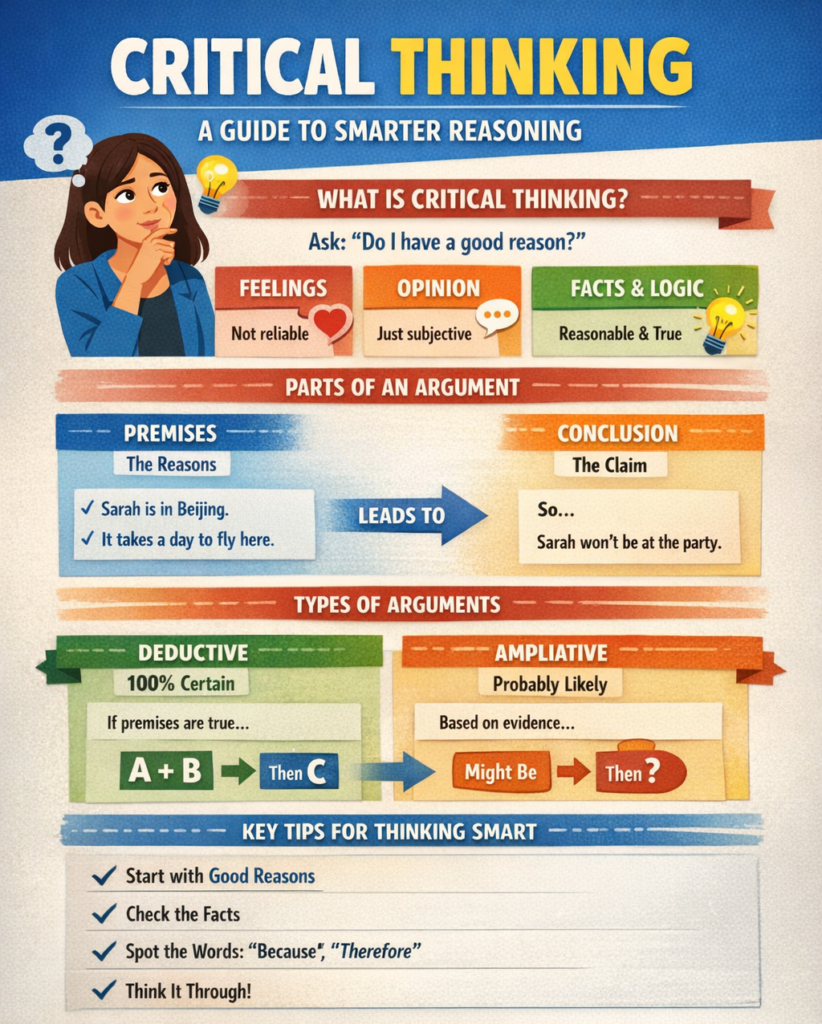
In introductory philosophy, critical thinking is usually described as the ability to evaluate reasons.
At a basic level, it involves asking:
“Do I have a good reason to believe this?”
We all hold beliefs about people, events, politics, and the world. Critical thinking does not mean rejecting beliefs by default. Instead, it involves examining whether a belief is supported by adequate reasons.
👀 Real-Life Example
Suppose a friend says:
“Sarah won’t be in class today.”
Rather than accepting the claim immediately, you ask:
“Why do you think that?”
Consider three possible answers and how strong each one is.
- “I don’t like Sarah and I want to enjoy class.”
🚫 This is a poor reason. A personal feeling does not provide evidence about Sarah’s attendance. - “Sarah often misses class.”
🟣 This is a reasonable reason. It does not guarantee the conclusion, but it makes it more likely. - “Sarah is in New York today and can’t get back in time.”
✅ This is a strong reason. If true, it makes the conclusion unavoidable.
Critical thinking consists in recognizing these differences and accepting conclusions only when they are adequately supported.
🧱 What Is an Argument?
In philosophy and logic, an argument is not a disagreement. It is a structured set of statements used to support a claim.
An argument has two basic components:
| Term | What it Means | Example |
|---|---|---|
| Premise | A reason or piece of evidence | “Sarah often misses class.” |
| Conclusion | The claim being supported | “So, Sarah won’t be in class today.” |
A useful way to remember this is:
- Premises answer “because”
- Conclusion answers “so”
🔍 Bad vs. Good Argument
Consider the following cases.
🚫 Weak Argument
- Premise 1: “I can’t stand Sarah.”
- Premise 2: “I want to enjoy class.”
- Conclusion: “Sarah won’t be in class.”
This is a weak argument. The premises have no logical connection to the conclusion.
✅ Strong Argument
- Premise 1: “Sarah is in New York.”
- Premise 2: “It’s impossible to get from New York to class today.”
- Conclusion: “Sarah won’t be in class.”
If the premises are true, the conclusion follows necessarily.
🧠 Two Types of Arguments: Deductive and Ampliative
Logic textbooks commonly distinguish between two broad kinds of arguments.
🔒 A. Deductive Arguments
Goal: certainty
In a deductive argument, if the premises are true, the conclusion must be true.
Example:
- Premise 1: “Sarah is in New York.”
- Premise 2: “She can’t travel back today.”
- Conclusion: “Sarah won’t be in class.”
This is a deductive argument.
If the premises are true, the conclusion is guaranteed.
🌱 B. Ampliative Arguments
Goal: probability
In an ampliative argument, the premises provide good reasons for the conclusion, but they do not guarantee it.
Example:
- Premise 1: “Sarah often misses class.”
- Conclusion: “Sarah won’t be in class today.”
This is an ampliative argument.
The conclusion is likely, but not certain. Sarah may still attend.
Most arguments used in everyday reasoning are ampliative rather than deductive.
🧠 Key Takeaways
- Critical thinking involves evaluating reasons for beliefs
- An argument consists of premises and a conclusion
- A good argument provides adequate support for its conclusion
- Deductive arguments aim at certainty
- Ampliative arguments aim at probability
🎶 Use This Song to Memorize It
🎧 While studying this, the core definitions were turned into a short song as a memory aid.
The song doesn’t add content, it simply repeats the same ideas in another form.
Lyrics are included below so you can read, sing, or listen along if repetition helps.
🎤 Song Lyrics:
(Sing, read, or hum along, repetition helps!)

🎶 Critical Thinking

Critical thinking, what’s it about?
It’s asking questions, having no doubt.
Before I believe, I check what's true,
“Do I have a good reason?” That’s what I do.

A good reason makes a belief more right,
It brings that idea into the light.
Not just feelings, not just belief
But logic and truth give real relief.

🧠 Premises first, conclusion last,
Build your argument strong and fast.
If your reasons make it likely or sure,
Then your thinking is clear and pure.
Yeah, good reasons, that’s the rule,
That’s how we think, that’s critical school.

An argument’s simple, here’s what it means:
A group of statements in logical scenes.
The reasons you give are the premises,
The claim they support is the conclusion, no guesses!

Premise one, premise two,
If they’re good, the conclusion’s true.
If they don’t connect, then it’s not sound,
Critical thinkers break that down.

Words like “because,” “since,” “given that,”
Show the premise, keep track of that.
Words like “therefore,” “so,” and “thus,”
Show conclusions, that’s a must.

🧠 Premises first, conclusion last,
Build your argument strong and fast.
If your reasons make it likely or sure,
Then your thinking is clear and pure.
Yeah, good reasons, that’s the rule,
That’s how we think, that’s critical school.

Now two types of arguments you need to know,
Deductive and ampliative, here we go.
Deductive: premises guarantee the end,
If they are true, the truth will extend.

No maybe, no might, it must be so,
If A and B, then C will flow.
Ampliative: not as tight,
The premises make the conclusion likely, not right.

It’s a guess, but a smart one too,
It helps you decide what’s probably true.

🧠 Premises first, conclusion last,
Build your argument strong and fast.
Deductive? Guaranteed truth, no lie.
Ampliative? Just probable, worth a try.
Yeah, good reasons, that’s the rule,
That’s how we think, that’s critical school.

Think it through before you believe,
Test your reasons, don’t be naive.
Good arguments give you power to see,
That truth and logic can set your mind free.
📝 Test Yourself: Reasons and Arguments
Read each case and decide before opening the answer.
Is this an argument? If so, how strong is it?
1. Premise 1: Sarah is in New York today. Premise 2: It takes more than a day to travel back. Conclusion: Therefore, Sarah won’t be in class today. ▾ Open to see answer
Deductive, Valid, and Sound
- Deductive: If the premises are true, the conclusion must be true.
- Valid: The conclusion follows from the premises.
- Sound: The premises are true in this scenario.
2. Premise 1: Sarah often misses class. Conclusion: So, Sarah probably won’t be in class today. ▾ Open to see answer
Ampliative Argument
- Why: The premise makes the conclusion likely, but does not guarantee it.
3. Premise: I want Sarah to be in class. Conclusion: Therefore, Sarah will be in class. ▾ Open to see answer
Not a Good Argument
- Why: A desire does not provide evidence for the conclusion.
4. Premise 1: If the lecture is cancelled, there will be no class. Premise 2: The lecture is cancelled. Conclusion: So, there will be no class. ▾ Open to see answer
Valid Deductive Argument
- Form: Modus ponens.
- Sound: if both premises are true.
5. Statement: “Sarah is the most motivated student in class.” ▾ Open to see answer
Not an Argument
This is a single claim. No reasons are given to support it.
6. Premise 1: All penguins are birds. Premise 2: All birds can fly. Conclusion: Therefore, all penguins can fly. ▾ Open to see answer
Valid but Not Sound
- Valid: The conclusion follows from the premises.
- Not sound: One premise is false.