📚 Topic: Introduction to Philosophy
What This Concept Is About
In introductory logic and critical thinking, philosophers study common mistakes in reasoning called fallacies.
One of these is the fallacy of division, an informal fallacy that comes from making an unjustified assumption about parts and wholes.
This fallacy appears when we move too quickly from a claim about a whole to a claim about its parts.
Canonical Definition
In standard logic textbooks:
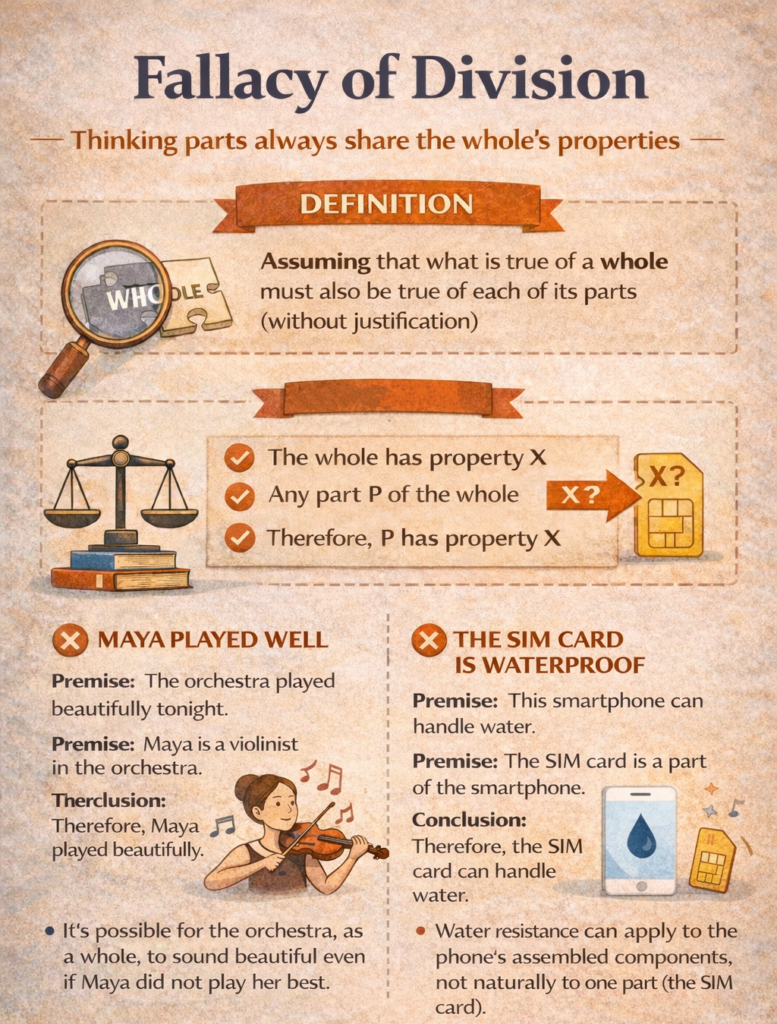
The fallacy of division occurs when someone assumes that what is true of a whole must also be true of each of its parts, without adequate justification.
The problem is not the logical form alone, but the content of the reasoning and the assumption being made.
The Core Idea in Plain Language
Sometimes a group, object, or system has a property that its individual parts do not have.
When we assume that every part must share the same property just because it belongs to the whole, we commit the fallacy of division.
Basic Structure of the Fallacy
| Step | Description |
|---|---|
| Premise 1 | The whole has property X |
| Premise 2 | Part P belongs to the whole |
| Conclusion | Therefore, part P has property X |
This reasoning feels natural, but it only works when there is a good reason to think the property transfers from whole to part.
Clear Examples
Example 1: Group vs Individual
Premise 1: The basketball team is very fast.
Premise 2: Alex is a member of the team.
Conclusion: Therefore, Alex must be very fast.
The team may be fast overall because of strategy or coordination.
That does not guarantee every individual player is fast.
This is a fallacy of division.
Example 2: Object vs Component
Premise 1: This laptop is durable and survives drops.
Prem️Premise 2: The battery is part of the laptop.
Conclusion: Therefore, the battery itself is durable and survives drops.
The laptop’s durability may depend on its casing or internal design.
The battery alone may not share that property.
Again, this is a fallacy of division.
Example 3: Abstract Property
Premise 1: This company is wealthy.
Premise 2: Maya works for the company.
Conclusion: Therefore, Maya is wealthy.
A company can be wealthy without its employees being wealthy.
The property does not automatically transfer.
Important Clarification
Not every argument that moves from whole to parts is fallacious.
The fallacy occurs only when there is no justification for the transfer.
When the Reasoning Is Not Fallacious
Premise 1: The house is painted entirely blue.
Premise 2: The front door is part of the house.
Conclusion: Therefore, the front door is blue.
Here, the conclusion follows because we are given a reason to believe the property applies to every part.
The reasoning is acceptable in this case.
Fallacy of Division vs Fallacy of Composition
These two fallacies are closely related but move in opposite directions.
| Fallacy | Mistake |
|---|---|
| Fallacy of Division | From whole to parts |
| Fallacy of Composition | From parts to whole |
Both involve unjustified assumptions about how properties transfer.
Why This Fallacy Matters
The fallacy of division shows up often in:
- Social and political arguments
- Workplace reasoning
- Marketing and branding claims
- Everyday judgments about people and groups
Learning to spot it helps slow down reasoning and avoid incorrect conclusions.
Summary Table
| Concept | Key Point |
|---|---|
| Fallacy Type | Informal fallacy |
| Core Error | Assuming parts share properties of the whole |
| Problem Area | Content, not logical form alone |
| Fix | Ask whether the property really transfers |
About the Song
While studying this concept, the core definition was turned into a short song as a memory aid.
The song does not add new content. It simply repeats the same ideas in a rhythmic form to support recall.
🎶 Use This Song to Memorize It
🎧 While studying this, the core definitions were turned into a short song as a memory aid.
The song doesn’t add content, it simply repeats the same ideas in another form.
Lyrics are included below so you can read, sing, or listen along if repetition helps.
🎤 Song Lyrics:
(Sing, read, or hum along, repetition helps!)

Fallacy of division

In logic class, in careful notes,
We learn how reasoning can fail.
Sometimes the mistake is not the form,
But where assumptions derail.

You look at something big and whole,
And think its parts must match it too.
That step feels natural, sounds okay,
But logic says: slow down, review.

🧠 Fallacy of division
Is when we wrongly assume
What’s true of the whole
Must also be true
Of each part inside it too

Fallacy of division
That mistaken move
From whole to parts
Without a reason to

The team is fast and wins each game,
But not each player runs the same.
The group looks strong when viewed as one,
That doesn’t mean each part has won.

The phone survives a heavy fall,
So someone trusts the screen alone.
But take it out, test just that part,
It cracks when left on its own.

🧠 Fallacy of division
Is when we wrongly assume
What’s true of the whole
Must also be true
Of each part inside it too

Fallacy of division
That mistaken move
From whole to parts
Without a reason to

This is an informal fallacy,
The content’s where it goes wrong.
The premises might all be true,
But the step just doesn’t belong.

Sometimes the move is justified,
But only when there’s reason why.
From whole to parts, pause and check,
Or logic quietly slips by.

🧠 Fallacy of division
Whole to parts assumed
What’s true of the whole
Is not always true
Of the pieces that compose it too

Fallacy of division
Remember this rule
From whole to parts
You need a reason to
🧠 Test Yourself: Fallacy of Division
For each item, decide first: is this a fallacy of division, or is it reasonable?
Then open to check.
1. Premise: The orchestra played beautifully tonight. Premise: Maya is a violinist in the orchestra. Conclusion: Therefore, Maya played beautifully tonight. ▾ Open to see answer
❌ Fallacy of Division (usually)
- Why: A group can perform well overall even if one member had an off night.
- Key pattern: “The whole has property X, so each part has property X.”
2. Premise: This loaf of bread is whole-grain. Premise: This slice came from that loaf. Conclusion: Therefore, this slice is whole-grain. ▾ Open to see answer
✅ Reasonable (not a fallacy)
- Why: “Whole-grain” is typically a property that carries down to slices.
- Note: Division isn’t “always wrong” — it’s wrong when there’s no justification.
3. Premise: This smartphone is waterproof. Premise: The SIM card is a part of this smartphone. Conclusion: Therefore, the SIM card is waterproof. ▾ Open to see answer
❌ Fallacy of Division
- Why: Waterproofing can be a feature of the assembled device (seals, casing), not of each component by itself.
4. Premise: The restaurant is expensive. Premise: The bread basket is part of what the restaurant serves. Conclusion: Therefore, the bread basket must be expensive. ▾ Open to see answer
❌ Fallacy of Division (likely)
- Why: The overall price level doesn’t force every single item to be expensive (some things can be free or cheap).
5. Premise: The city is busy and noisy at night. Premise: This small park is inside the city. Conclusion: Therefore, the park must be busy and noisy at night. ▾ Open to see answer
❌ Fallacy of Division (likely)
- Why: The city can be noisy overall while some parts (parks, side streets) stay quiet.
6. Premise: Water is wet. Premise: A single water molecule is a part of water. Conclusion: Therefore, a single water molecule is wet. ▾ Open to see answer
❌ Fallacy of Division (classic example)
- Why: “Wet” is usually a property of collections of molecules (how they behave together), not of one molecule by itself.