📚 Topic: Introduction to Philosophy
What Is an Abductive Argument?
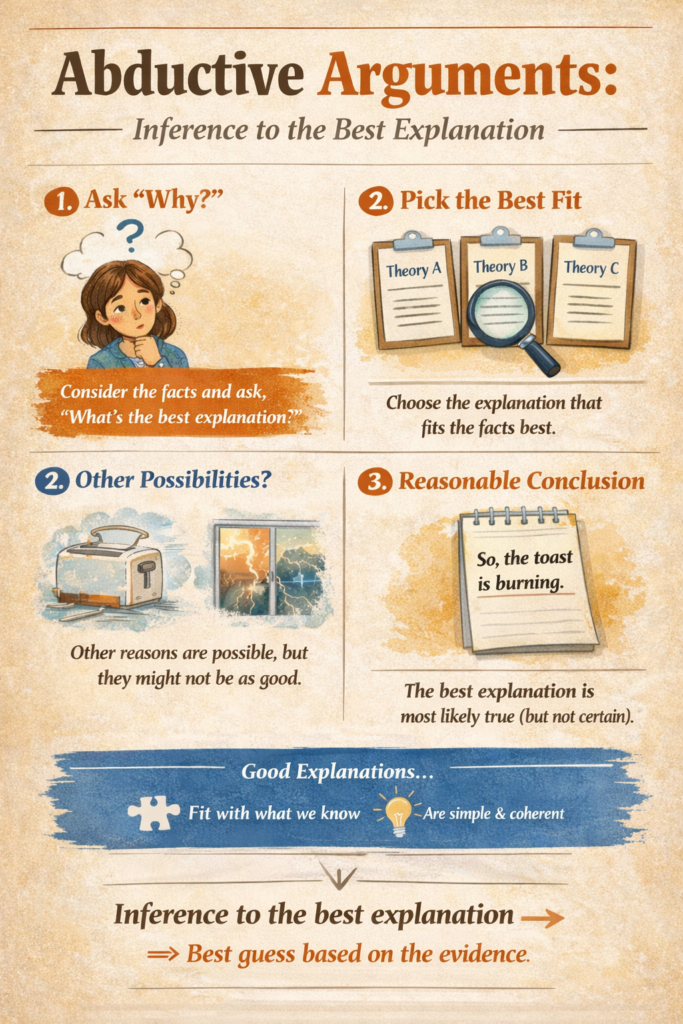
In logic and philosophy of science, abduction is a form of reasoning often described as inference to the best explanation.
An abductive argument begins with an observation and proposes a hypothesis that, if true, would best explain that observation.
Unlike deductive arguments, abductive arguments do not aim at certainty.
Unlike inductive arguments, they are not based on statistical generalization.
They aim instead at explanatory plausibility.
A Simple Example
- Observation: Your roommate comes home soaking wet.
- Conclusion: It probably started raining outside.
You did not observe the rain directly.
However, rain provides a better explanation than alternatives such as accidental immersion or deliberate soaking.
This is an abductive inference.
Additional Examples
Everyday reasoning
- Observation: There is a strong smell of burning in the kitchen.
- Conclusion: The toast in the toaster is burning.
This explanation fits what is observed and requires no additional assumptions.
Medical reasoning
- Observation: Sore throat, headache, and chills.
- Conclusion: You may be getting sick.
The conclusion is not guaranteed, but it explains the symptoms better than most alternatives.
Social reasoning
- Observation: A student who usually participates actively is silent all day.
- Conclusion: They may be tired, distracted, or upset.
Again, the conclusion is provisional, but explanatory.
What Makes an Explanation Better Than Another?
Not all explanations are equally good. In abductive reasoning, explanations are typically evaluated using criteria such as the following.
1. Consistency with background knowledge
A good explanation fits with what is already well established.
- Observation: You smell smoke.
- Plausible explanation: Someone is cooking.
- Implausible explanation: Extraterrestrial signaling.
The second explanation conflicts with a large body of background knowledge and is therefore weaker.
2. Simplicity
When competing explanations fit the facts equally well, the simpler explanation is generally preferred.
- Observation: Your friend is limping.
- Simple explanation: They injured their foot.
- Overly complex explanation: A long sequence of unlikely events.
Without additional evidence, simplicity counts in favor of the first explanation.
How Abductive Arguments Can Be Challenged
Because abductive arguments are not conclusive, they are open to revision.
Offering a better explanation
A conclusion may be replaced if a new explanation fits the evidence better.
- Initial explanation: Your partner forgot your birthday.
- New evidence: They were planning a surprise.
The new explanation accounts for the same facts more effectively.
Gathering more evidence
Additional information can change which explanation is best.
- Initial observation: A burning smell in the kitchen.
- Further evidence: The toaster is off, but a pizza is burning in the oven.
The conclusion is updated accordingly.
Key Points
- Abductive arguments aim at the best explanation of what is observed.
- They provide plausible hypotheses, not proofs.
- Good explanations fit well with background knowledge and avoid unnecessary complexity.
- Abductive reasoning is common in everyday life, science, medicine, and diagnosis.
🎶 Use This Song to Memorize It
🎧 While studying this, the core definitions were turned into a short song as a memory aid.
The song doesn’t add content, it simply repeats the same ideas in another form.
Lyrics are included below so you can read, sing, or listen along if repetition helps.
🎤 Song Lyrics:
(Sing, read, or hum along, repetition helps!)

🎵 The Best Explanation

Why did the room feel strange today?
Why was the window open that way?
I look at the facts, the clues I can find
And try to explain what’s on my mind

🧠 Abductive reasoning, this is the way
We guess the cause when facts don’t say
Not what must be, just what fits best
The simplest answer beats the rest

It’s not deductive, no guarantee
But it’s the best guess based on what we see
When truth is hidden, but clues are near
We choose what makes the picture clear

🧠 Abductive reasoning, this is the way
We guess the cause when facts don’t say
Not what must be, just what fits best
The simplest answer beats the rest

Not just a hunch, not wild or bold
But what explains the facts we hold
From science labs to daily life
We use abduction to make it right

Abductive reasoning, think it through
Ask: “What explains what I see as true?”
Not certain truth, but reasoned grace
The best explanation takes its place
🧠 Self-Check: Abductive Reasoning
For each case, identify the explanation that best accounts for the observation.
Decide before opening the explanation.
1. Observation: The fridge is warm inside and food is spoiling. ▾ Open to see answer
Abductive conclusion: The fridge is broken or unplugged.
- Why: This explanation is simple and consistent with background knowledge.
2. Observation: A usually responsive friend has not replied all day. ▾ Open to see answer
Abductive conclusion: Their phone is off, unavailable, or they are busy.
- Why: This explanation fits common experience better than more extreme alternatives.
3. Observation: Scratching sounds are heard in the attic at night. ▾ Open to see answer
Abductive conclusion: There may be small animals in the attic.
- Why: This explanation requires fewer assumptions than supernatural or criminal causes.
4. Observation: A coworker closes their laptop when you enter the room. ▾ Open to see answer
Abductive conclusion: They were engaged in a private activity.
- Why: Privacy concerns explain the behavior without attributing hostile intent.
5. Observation: A student appears tense and repeatedly taps their pen during a test. ▾ Open to see answer
Abductive conclusion: The student is anxious or struggling with a question.
- Why: This explanation aligns with common test behavior.
6. Observation: The street outside is wet, but the sky is now clear. ▾ Open to see answer
Abductive conclusion: It likely rained earlier.
- Why: Recent rain explains the observation better than ongoing causes.
7. Observation: Your computer suddenly shuts down and feels very hot. ▾ Open to see answer
Abductive conclusion: The computer overheated.
- Why: Overheating is a common and sufficient explanation for sudden shutdowns.
8. Observation: A normally punctual colleague arrives late several days in a row. ▾ Open to see answer
Abductive conclusion: There may be an ongoing issue affecting their schedule.
- Why: A repeated pattern suggests a stable explanation rather than coincidence.