📚 Topic: Introduction to Philosophy
What Is a Sound Argument?
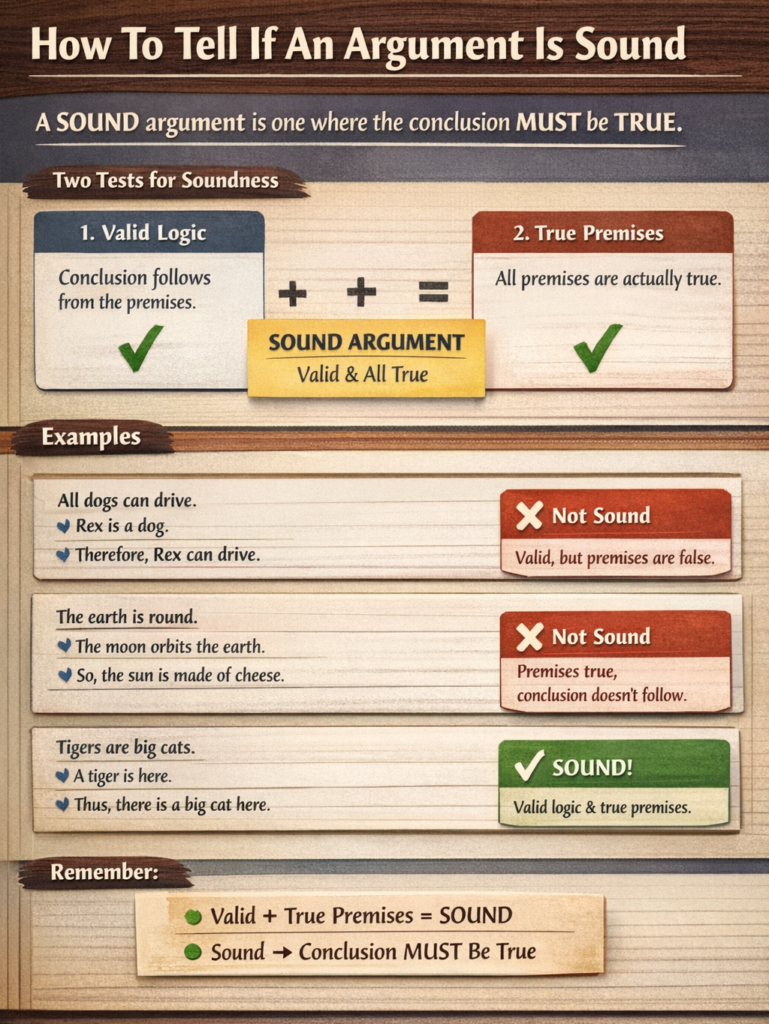
In logic, an argument is sound when two conditions are met:
- The argument is valid, the conclusion follows logically from the premises.
- All the premises are true.
If both conditions hold, the conclusion must be true.
Soundness therefore combines correct reasoning with accurate information.
Why Soundness Matters
Validity alone is not enough to guarantee truth.
A valid argument only tells us that if the premises were true, the conclusion would follow.
Soundness goes further.
It asks whether the premises actually match reality.
When an argument is sound, its conclusion is not just logically supported — it is true.
A Valid but Unsound Argument
- Premise 1: All flowers can sing opera.
- Premise 2: This plant is a flower.
- Conclusion: This plant can sing opera.
The structure of this argument is valid.
If the premises were true, the conclusion would follow.
However, the premises are false.
For that reason, the argument is not sound.
This shows that validity does not guarantee truth.
A Sound Argument
- Premise 1: Penguins are birds.
- Premise 2: Penguins cannot fly.
- Conclusion: Therefore, not all birds can fly.
The reasoning is valid, and the premises are true.
Because both conditions are satisfied, the argument is sound, and the conclusion must be true.
True Premises Are Not Enough
An argument can contain true statements and still fail to be sound if the reasoning is invalid.
- Premise 1: The sun is hot.
- Premise 2: My tea is hot.
- Conclusion: Therefore, my tea is the sun.
Both premises are true.
The conclusion does not follow.
Because the argument is invalid, it is not sound.
How to Check for Soundness
To determine whether an argument is sound, proceed in this order:
- Check validity
Ask whether it is possible for the premises to be true while the conclusion is false. - Check truth
Ask whether the premises are actually true.
Only if both tests are passed is the argument sound.
Summary Table
| Concept | What it refers to | Why it matters |
|---|---|---|
| Validity | Logical structure | Ensures the conclusion follows |
| Truth | Accuracy of premises | Ensures connection to reality |
| Soundness | Validity + true premises | Guarantees a true conclusion |
🎶 Use This Song to Memorize It
🎧 While studying this, the core definitions were turned into a short song as a memory aid.
The song doesn’t add content, it simply repeats the same ideas in another form.
Lyrics are included below so you can read, sing, or listen along if repetition helps.
🎤 Song Lyrics:
(Sing, read, or hum along, repetition helps!)

Sound is True

You say it’s valid, but is it sound?
Do the facts hold when you write them down?
Logic alone won't make it true
You need real-world truth to carry it through.

A valid argument has form that fits,
But even nonsense can sit in it.
“All cats wear hats,” sure, that’s tight
But soundness checks if you got it right.

✅ Sound is valid + the truth is clear,
Both together, and the path appears.
If the steps make sense and the facts are right,
The conclusion shines with a steady light.
That’s soundness, logic plus truth in flight.

False premise? No matter how neat,
It means the argument’s incomplete.
“All ghosts eat cake” might make you smile,
But don’t count on it to last a while.

True premise, valid shape
Now your reasoning holds weight.
Only then, we nod and say:
“That conclusion’s true today.”

✅ Sound is valid + the truth is clear,
Both together, and the path appears.
If the steps make sense and the facts are right,
The conclusion shines with a steady light.
That’s soundness, logic plus truth in flight.

So next time someone makes a claim,
Check the truth and logic frame.
Don’t just nod, take a stand:
Ask if it’s sound, and you’ll understand.
Self-Check: Is the Argument Sound?
For each case, decide whether the argument is valid, whether the premises are true, and whether it is sound.
1. Premise 1: All books are made of paper. Premise 2: My journal is a book. Conclusion: My journal is made of paper. ▾ Open to see analysis
Sound
- The reasoning is valid.
- The premises are true in ordinary contexts.
2. Premise 1: All cats have wings. Premise 2: Lulu is a cat. Conclusion: Lulu has wings. ▾ Open to see analysis
Valid, but not sound
- The structure is valid.
- A premise is false.
3. Premise 1: Apples are fruits. Premise 2: Bananas are fruits. Conclusion: Bananas are apples. ▾ Open to see analysis
Invalid, not sound
- The conclusion does not follow from the premises.
4. Premise 1: If it rains, the picnic is cancelled. Premise 2: It is raining. Conclusion: The picnic is cancelled. ▾ Open to see analysis
Sound
- This is a valid deductive form (modus ponens).
- The premises are assumed to be true.
5. Premise: I wish I were taller. Conclusion: I must be short. ▾ Open to see analysis
Not valid, not sound
- The conclusion does not follow from the premise.