📚 Topic: Introduction to Philosophy
What Is a Deductive Argument?
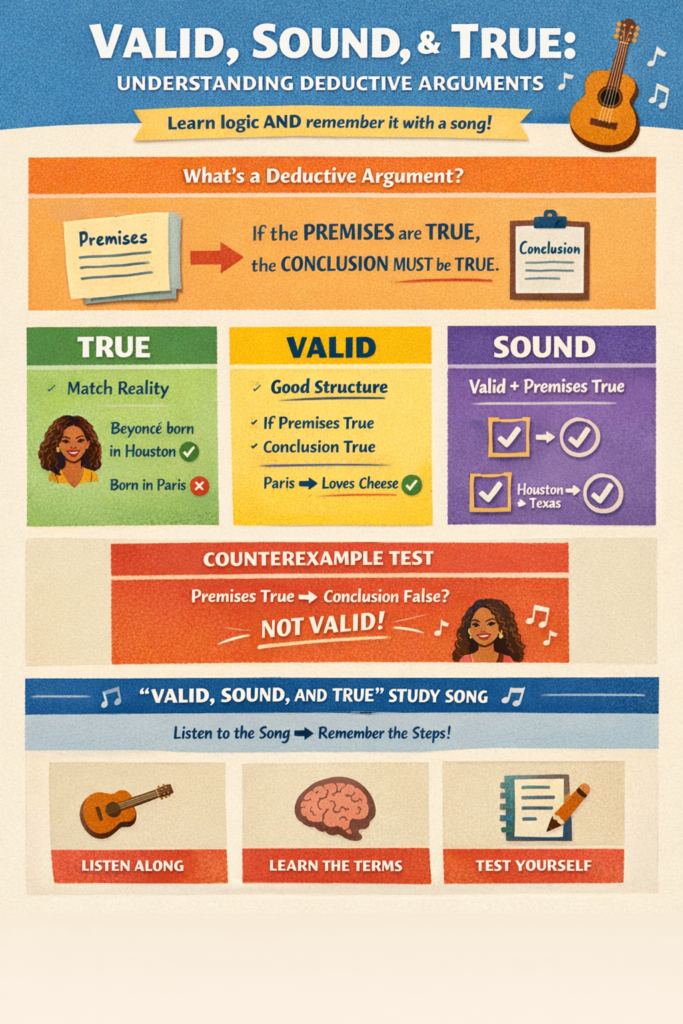
In logic, a deductive argument is a form of reasoning in which, if the premises are true, the conclusion must be true.
Deduction is not about making a good guess or offering a plausible explanation. It is about whether the conclusion follows necessarily from the premises.
Example:
- Premise 1: All birds have feathers.
- Premise 2: A penguin is a bird.
- Conclusion: A penguin has feathers.
If the premises are true, the conclusion cannot be false. This is characteristic of deductive reasoning.
Three Related but Distinct Concepts
Introductory logic distinguishes between truth, validity, and soundness. These terms are often confused, but they apply to different things.
Truth
Truth applies to individual statements.
A statement is true if it matches reality.
Examples:
- “Beyoncé was born in Houston.” → true
- “Beyoncé was born in Paris.” → false
Truth is a matter of fact. It does not, by itself, determine whether an argument is good.
Validity
Validity applies to arguments, not individual statements.
An argument is valid if the conclusion follows logically from the premises.
This depends on the structure of the argument, not on whether the premises are actually true.
Example (valid but not sound):
- Premise 1: Beyoncé was born in Paris.
- Premise 2: Everyone born in Paris loves cheese.
- Conclusion: Beyoncé loves cheese.
The premises are false, but if they were true, the conclusion would follow. For that reason, the argument is valid.
Soundness
Soundness also applies to arguments.
An argument is sound when:
- the argument is valid, and
- all of its premises are true.
Example (valid and sound):
- Premise 1: Beyoncé was born in Houston.
- Premise 2: Everyone born in Houston was born in Texas.
- Conclusion: Beyoncé was born in Texas.
This argument has a valid structure and true premises, so it is sound.
How to Test for Validity
A common test for validity is the following question:
Could the premises be true while the conclusion is false?
- If yes → the argument is not valid
- If no → the argument is valid
Example (invalid):
- Premise 1: Classical musicians appreciate opera.
- Premise 2: Beyoncé is not a classical musician.
- Conclusion: Beyoncé does not appreciate opera.
Even if the premises are true, the conclusion does not have to be. The argument is therefore invalid.
Recap Table
| Term | Applies to | Meaning |
|---|---|---|
| True | Statement | Matches reality |
| Valid | Argument | If the premises are true, the conclusion must be true |
| Sound | Argument | Valid argument with all true premises |
🎶 Use This Song to Memorize It
🎧 While studying this, the core definitions were turned into a short song as a memory aid.
The song doesn’t add content, it simply repeats the same ideas in another form.
Lyrics are included below so you can read, sing, or listen along if repetition helps.
🎤 Song Lyrics:
(Sing, read, or hum along, repetition helps!)

Valid, Sound, and True

A deductive argument’s made
When the truth is clearly laid.
If the premises are true,
Then the conclusion must be too.

“Valid” is a special word,
Not just how it’s often heard.
If the reasons all hold tight,
Then the ending comes out right.

🧠 Valid, sound, and true,
Each one does what it’s meant to do.
Truth is what matches fact,
Valid’s when logic keeps intact.
Sound is both, structure and truth,
That’s the clearest reasoning proof.

You can be valid and still be wrong,
When the premises don’t belong.
Say Beyoncé’s from Paris,
Say she loves her brie
The logic holds, but truth is gone,
Because the facts don’t make it so.

To be sound, you must combine
Valid steps and truth in line.
Houston’s where she came to be,
Texas holds her history.
When the steps and facts align,
The argument is sound, just fine.

🧠 Valid, sound, and true,
Each one does what it’s meant to do.
Truth is what matches fact,
Valid’s when logic keeps intact.
Sound is both, structure and truth,
That’s the clearest reasoning proof.

Try a case that feels just right,
But the ending isn’t tight.
If the premises are fine,
Yet the conclusion crosses lines,
Then the logic isn’t pure,
And the argument’s not valid, for sure.

So don’t just trust the way it sounds,
Check the truth and logic grounds.
To know what truly follows through,
Ask: is it valid, sound, and true?
📝 Self-Check: Validity, Soundness, and Truth
For each case, identify whether it concerns truth, validity, or soundness.
Decide before opening the explanation.
1. Premise 1: All cats are mammals. Premise 2: Luna is a cat. Conclusion: Therefore, Luna is a mammal. ▾ Open to see answer
Valid and Sound
- Valid: The conclusion follows from the premises.
- Sound: The premises are true.
2. Premise 1: Everyone born in Paris loves cheese. Premise 2: Beyoncé was born in Paris. Conclusion: Therefore, Beyoncé loves cheese. ▾ Open to see answer
Valid but Not Sound
- Valid: The logical structure is correct.
- Not sound: At least one premise is false.
3. Premise 1: All fish can fly. Premise 2: Goldie is a fish. Conclusion: Therefore, Goldie can fly. ▾ Open to see answer
Valid but Not Sound
- Valid: The conclusion follows from the premises.
- Not sound: A premise is false.
4. Premise 1: People in bands like music. Premise 2: Chris is not in a band. Conclusion: Therefore, Chris does not like music. ▾ Open to see answer
Invalid
- Reason: The conclusion does not follow from the premises.
5. Statement: The Earth orbits the Sun. ▾ Open to see answer
True (but not an argument)
This is a single statement and does not contain reasoning.